

It is not a matter of chemistry, but of psychology: how the act of protecting ourselves deactivates our prudence and pushes us toward an exposure our bodies cannot afford.
By Ehab Soltan
HoyLunes — There is a small ritual that almost all of us repeat mechanically every morning in front of the mirror. It is that sharp click of a container’s lid, followed by the cool trace of cream spreading across the face. In that instant, something happens that has nothing to do with science: we feel a strange, almost comforting satisfaction.
It is the sound of a task checked off a list. You look at yourself, give the green light, and step out into the street with renewed confidence. It is as if you had just purchased a comprehensive life insurance policy for your skin that allows you to ignore the sky for the next ten hours.
That is, precisely, the problem. We have learned to trust the product so much that we have stopped listening to our instinct. Sunscreen works as a physical barrier, yes, but in our heads, it operates in a much more perverse way: as a psychological painkiller.
In psychology, they call it Risk Compensation. It is that treacherous mechanism that whispers to us that, because we are wearing a helmet, we can pedal faster, or that, because we are wearing SPF 50, the midday sun is little more than decorative lighting. We apply the protection and, in that very act, we grant ourselves an invisible permission to stop being careful.
Tell me one thing: Do you expose yourself to the sun because the day is pleasant, or because you believe your cream has made you immune to it?

The Invisible Permission
The most fascinating (and dangerous) part is what happens at the exact moment the product finishes absorbing. It is not a conscious decision; you don’t say to yourself: “Now that I’m wearing cream, I’m going to punish my skin”. It is something much more subtle, a silent adjustment in your prudence thermostat.
Think about it for a second. That invisible shield redefines dozens of small decisions you make throughout the day without giving them a second thought:
It is the natural inclination to walk on the sunny sidewalk instead of seeking shade (“after all, I already put it on”).
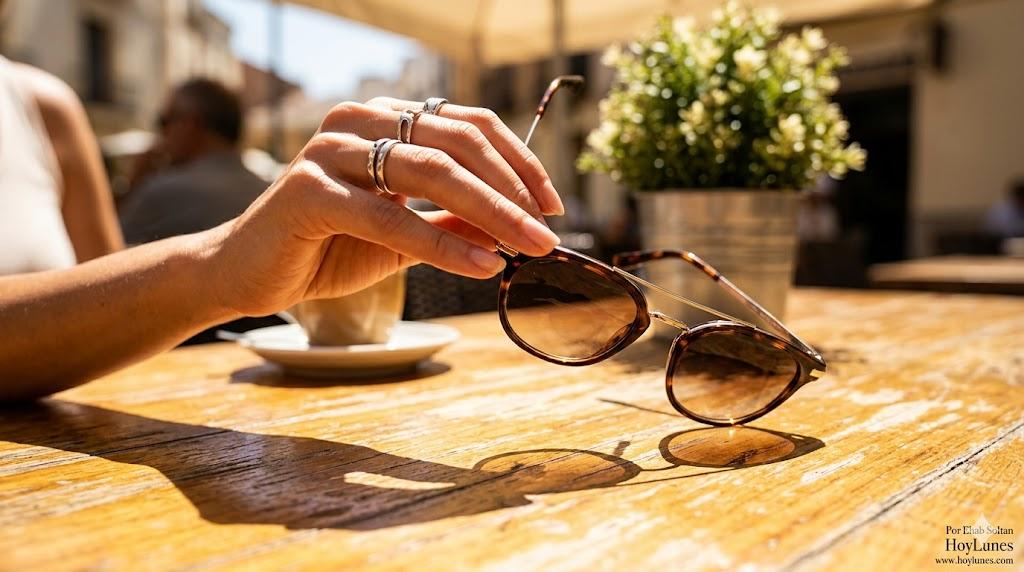
It is deciding that today you don’t need a hat or sunglasses because the protection task is already marked as “completed”.
It is that feeling that the midday sun—the one that bites—seems more manageable today, almost harmless.
And, above all, it is the automatic omission of reapplication. Because, let’s face it: we feel protected by the memory of having applied the cream at eight in the morning, not by the actual amount of filters remaining on our skin four hours later.
None of these decisions seem critical on their own. But together, they are a trap. It’s not that the formula is insufficient; it’s that our interpretation of its scope is excessive. We are living under a paradox: we believe we are reducing exposure when, in reality, we are often just redistributing it. We spend more time under the sun simply because we feel we have permission to be there.
The Paradox of Control
Sometimes I wonder if we have turned skin care into a kind of “creative accounting”. We apply the product and, automatically, we open a line of credit for time under the sun that our body, in reality, cannot pay back.
The problem is that sunscreen intervenes in a dynamic system, not a statue. While the formula fights photons on the surface, your mind is doing something much more complex: it is recalculating your vulnerability. And it almost always errs on the side of imprudence.
It is a haunting paradox. The more you integrate the application into your routine, the easier it is to relax your attention on your surroundings. You stop looking at the context—the actual intensity of the light, the reflection on the asphalt, the lack of a breeze—to focus only on the gesture. You convince yourself that the job is already done.
And this is where the suspicion becomes uncomfortable. If cumulative damage (the Exposome) is built on the sum of tiny journeys and pauses, how much of that radiation is reaching us precisely because we feel “safe”? Perhaps the final outcome of our day depends not so much on the cream, but on all the imprudences we committed because we were wearing it.
A Trajectory Without Obvious Errors
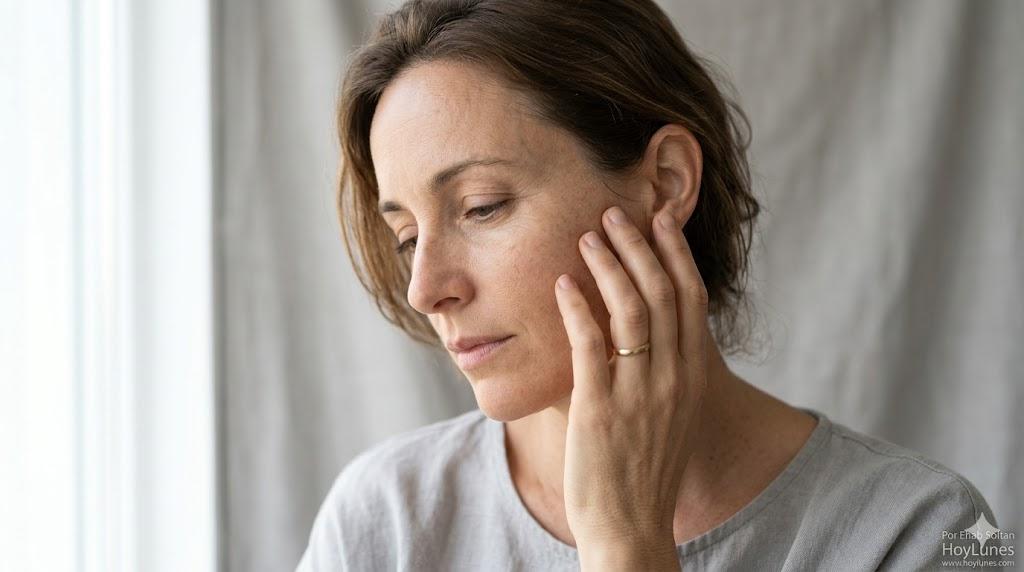
My colleague Marta, who doesn’t mind me sharing her experience, is the perfect example of this. At 41, Marta is disciplined. She uses sunscreen every morning with enviable consistency. For years, she has walked through life with the peace of mind of someone who knows they are doing the right thing.
And, technically, she was.
But that very security led her, almost imperceptibly, to relax the rest of her defenses. Marta spends more time outdoors than she would if she felt the sun directly on her bare skin. She trusts that the initial gesture covers her coffees on the terrace and her walks under a merciless sun.
Over time, her skin began to change. It wasn’t an abrupt disaster. Simply, one day she realized her skin no longer responded as it used to; marks appeared, along with a texture that betrayed a deep biological fatigue.
Marta had not stopped protecting herself. She had stopped observing what she did afterward. She was a victim of her own diligence. Her error was not a lack of cream, but a blind faith in it. She forgot that sunscreen is not a science-fiction force field, but a tool that, if it makes us drop our guard, ends up exposing us more than if we were wearing nothing at all.
A Necessary Confession
The unsettling part of writing this article is that I caught myself doing exactly the same thing. I, too, have felt that small artificial tranquility after applying sunscreen in the morning. That silent sensation that the problem was already under control and that I could turn my gaze to other things.
And perhaps therein lies the ultimate trap: we don’t usually drop our guard when we ignore the risk. We drop it when we believe we have managed it.
Questions That Do Not Interrupt, But Linger
At what exact moment do we stop relating to the sun and start relating only to the sensation of being safe from it? Perhaps the key is not in the brand of the cream, nor the SPF number, but in everything that happens afterward:
In that small mental relaxation when stepping out into the street.
In how the body drops its guard when the mind feels the problem is already “resolved”.
In all those tiny decisions that seem insignificant until they accumulate over twenty years in front of the mirror.
Human beings rarely decide based on pure logic; they almost always decide based on perception. Perhaps protecting the skin is not just about applying a product. Perhaps it also involves the extra effort of maintaining awareness of the environment even after having done so. Continuing to observe the light. Continuing to understand the context. Continuing to remember that feeling protected does not always mean being less exposed.
In the end, perhaps this is one of the most silent contradictions of our time: sometimes danger does not begin when we ignore the risk. It begins when we stop looking at it because we believe we have resolved it.
#ConsciousPhotoprotection #RiskPsychology #SkinHealth #HumanBehavior #HoyLunes #EhabSoltan